Research · Curation · Public scholarship
Dalí’s Dialogues
Exploring the Salvador Dalí prints at the Hallie Ford Museum of Art.
By Matthew Mahoney · November 1, 2024
ProjectPresidential scholarship
PlaceHallie Ford Museum of Art
Salem, Oregon
WorkFive catalogues, an exhibition, lectures & podcast episodes
The complete project essay · 2024
Hello, I’m Matthew Mahoney, and today, I'm thrilled to share my presidential scholarship project on Salvador Dali as my first blog post. This project, carried out at the Hallie Ford Museum of Art, involved translating, compiling, and interpreting five of Dali’s remarkable print portfolios, resulting in the creation of publicly accessible catalogues and a curated exhibition. The journey included deep archival research, careful translation work, digital catalog creation, and the curation of an exhibition, each step contributing to a deeper understanding of Dali's work. This project was worked on as an undergraduate senior art history student at Willamette University.
The Discovery of Five Salvador Dali Portfolios
During my time at the Hallie Ford Museum in spring of 2023, I came across five unique Dali portfolios: Don Quixote, Le Tricorne, Alchemy of the Philosophers, Poems by Mao Tse-Tsoung, and Les Caprices. These portfolios, accompanied by Dali's surrealist prints interpreting each text, represented an invaluable collection. Not many museums have access to complete Dali portfolios, which makes the Hallie Ford's collection exceptionally rare.
Each page and print had been individually catalogued in the museum’s database, but the low-quality images and scattered data entries made it difficult to view them as cohesive books. I realized that organizing these works into digital catalogue books would significantly improve accessibility for scholars, students, and the public.
Structuring the Presidential Scholarship Project
Upon receiving the presidential scholarship, I outlined my project to include four key elements: high-quality photography and digital catalog creation and curating an exhibition from the portfolios along with lectures and podcast episodes continuing my work reevaluating Surrealism.
Throughout summer 2023, I visited the museum weekly, using a high-resolution Canon camera to photograph each print, transcribing and translating the accompanying texts, and editing these elements into digital catalogues. In this post are the digital catalogues for public access and view.
Curating Dali’s Dialogues: Discourses between the Past and the Present
The exhibition I curated, Dali’s Dialogues, focused on Dali’s reinterpretative conversations with classic texts. I selected six prints from the Don Quixote, Le Tricorne, and Les Caprices portfolios, complemented by two prints from Goya’s original Les Caprices. This allowed visitors to see Dali’s work in dialogue with Goya, an artist he respected. Curating these pieces and writing their interpretive labels provided me an opportunity to dive into each print’s deeper meaning.
The Story Behind the Portfolios
Starting in the 1950s, Dali was commissioned by many book publishers to illustrate editions of classic literature or anthologies, creating portfolios that merged his unique surrealist iconography with famous literary works. Here’s a closer look at the five portfolios I studied:Don Quixote (1957, Joseph Foret): Dali’s Don Quixote suite includes 12 lithographs depicting the legendary knight's adventures. With his eccentric, bullet-splattered prints, Dali transforms Cervantes’ novel into a surreal spectacle that blurs the line between reality and imagination. For example, The Golden Age print showcases Don Quixote’s utopian vision, where Dali employs symbolism like an acorn, a cornucopia-like sign of abundance.Le Tricorne (1959): Illustrating Pedro Antonio de Alarcon's classic, this suite of 21 prints captures the romantic misadventures of Tio Lucas and Seña Frasquita. The prints use vivid colors, such as rich golds to evoke Spanish landscapes, alongside Dali's whimsical representations of butterflies and donkeys. Butterflies signify metamorphosis and beauty, while donkeys symbolize human folly, traits central to Dali’s interpretation.Alchemy of the Philosophers (1960): This 12-print anthology includes alchemical symbols, with prints exploring the fusion of masculine and feminine as represented by the alchemical hermaphrodite. Dali often portrayed his wife, Gala, as his muse and the feminine force in his life, intertwining her image into the prints to symbolize this philosophical concept.Poems by Mao Tse-Tsoung (1967): Dali’s ten lithographs for Mao’s poetry blend his surrealistic style with themes from Eastern philosophy, reflecting Mao's influence on the period’s counter-cultural and intellectual circles. Mao Tse-Tsoung is also known as Mao Zedong, the Chinese communist leader.Les Caprices (1977): In this reinterpretation of Goya’s Les Caprices series, Dali added his signature surreal touches to Goya’s critiques of Spanish society. For instance, Dali’s version of All Will Fall reimagines Goya’s original work with references to Heisenberg’s Uncertainty Principle, a nod to the ambiguity in Goya’s critique of decadence.
Deeper Exploration of the Portfolios
Don Quixote (1957)
This edition was made for the publisher Joseph Foret, which is the version in the Hallie Ford’s collection, after having already created another one for the Illustrated Modern Library of New York in 1946.
To give some background, Don Quixote, written by Miguel de Cervantes, and published in 1605, has been considered the first modern novel. The book depicts a self-declared, ill-suited, and literature-fed knight Don Quixote and his faithful squire Sancho Panza inspired by the chivalry of Spanish crusaders, embarking on a non-sensical quest in the sixteenth century to right all the wrongs in the land including by fighting “giants” who turn out to be windmills. The story blurs the line between reality and perception of reality. Dali’s interest in the story may partly be from his self-declaration that “the only difference between me and a madman is that I am not mad.”
Dali was hesitant to create another edition when approached by Joseph Foret, partly because he was fundamentally opposed to the lithograph medium which is a process of applying ink to stone and thought it was “a liberal, bureaucratic, and soft process… without strength, monarchy, and inquisition.” The persistence of the publisher as well as their willingness to deliver the 135-million-year-old calcareous slate lithograph stones from Paris to Dali’s home in Port Lligat, Spain convinced Dali to do it. It also helped that he was able to create an interest in lithography by experimenting with the medium. He shot bullets of ink towards the stone to make violent, abstract, gestural smears in the prints echoing the French action painting movement Tachisme which he knew and appreciated. He also created patterns of ink from rhinoceros horns, snail-like ammonite fossils, sea urchins, squids, frogs, and even hedgehogs.
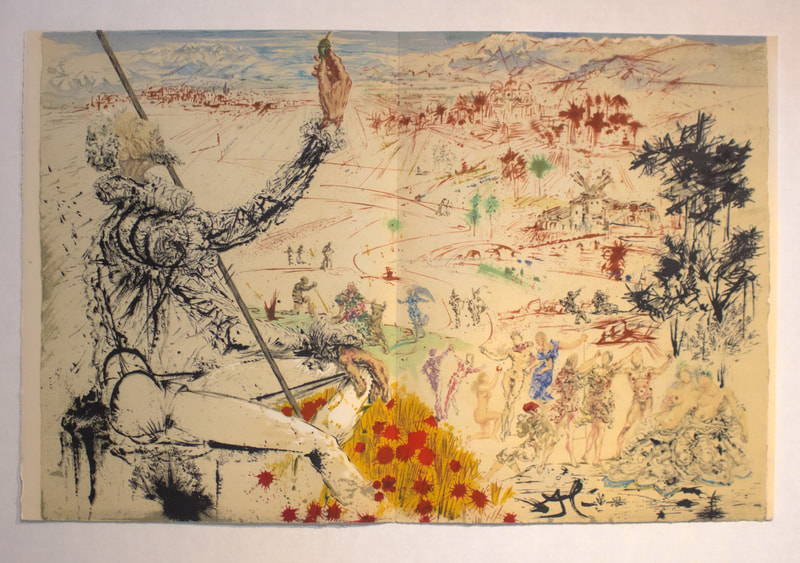
In one of the prints in the exhibition, called the Golden Age, which is from this portfolio, we see the most tranquil composition in the whole suite which depicts a Don Quixote holding an acorn and surveying a landscape. In this scene, he goes on a rant about a Golden Age where humans will no longer suffer work and be able to live off the land. The acorn embodies a similar symbolism of abundance to the cornucopia. In the landscape are a procession of figures meant to be Europa and the bull mingling with angels and biblical figures. They are meant to represent a genealogy of time, a bridge between the past and the present, and a legacy of great literature.
Le Tricorne (1959)
A year later, in 1959, Dali also created the Le Tricorne portfolio with 21 prints published by the Nouveau Cercle Parisien du Livre and Editions du Rocher, Monaco. Le Tricorne is another classic Spanish literary work. Known in Spanish as “El Sombrero de Tres Picos” or in English as “the Three-Cornered Hat”, Le Tricorne is a 1874 short novel by Pedro Antonio de Alarcon that details amorous exploits and mistaken identity set in the eighteenth century. It details the journey of a miller named Tio Lucas and his attractive wife Seña Frasquita who are madly in love even after years of marriage. Many characters are attracted to his wife and the villain is magistrate Mayor Don Eugenio, a man who pursues the miller’s wife and wears the hat that the title mentions. The book was turned into a ballet in 1919 by Manuel de Falla with Pablo Picasso as designer of the sets, costumes, and monumental stage curtain.
Le Tricorne, in contrast to the more violent and gestural Don Quixote suite, demonstrates Dali’s draftsman skills in more traditional book illustrations. He uses predominantly rich colors to suggest the nobility of the characters’ world and employs a sunny golden-yellow color to capture the Spanish landscape. In this edition, Dali also tries to balance the beautiful with the morbid. This balance is best struck by the balance between butterflies, embodying natural beauty, as well as donkeys, embodying ugly human traits of deceit, foolishness, and sexual immaturity.
In Le Tricorne, as is the case in the Frontispiece in the exhibition, butterflies can be seen in the costumes and the staffs of the various characters as well in 7 prints. Butterflies in Dali’s work also represent metamorphosis and transformation.
Donkeys, including shadows of donkeys, appear in 13 separate prints including this one in the exhibition from page 103. In the original story by Alarcon, when the miller and his wife don’t recognize each other as they pass in the dark, their donkeys do recognize each other and bray, suggesting that animals aren’t as easily deceived and therefore, as foolish, as human beings.
Alchemy of the Philosophers (1960)
In the next year 1960, for Editions Art Et Valeur, he produced 12 large prints for an original anthology of various alchemical texts from Greek, Jewish, Arabic, Indian, Chinese, Latin, and Medieval cultures called Alchemy of the Philosophers.
For context, alchemy was the medieval predecessor of chemistry and has been associated with the occult, magic, and witchcraft. The alchemist was primarily interested in the fusion of male and female into a creation of the Philosopher’s Stone, a physical object that possesses the power to turn base metals into gold, give immortality, cure disease, and give philosophical enlightenment. Hermaphrodites is a recurring symbol to represent the fusion of male and female in alchemy and can be seen in multiple prints of Dali’s portfolio.
I want to point out something in one of the prints in the alchemy portfolio I found interesting but didn’t work for the exhibition. Dali produced this print called “Immortality”, an image of the accomplished alchemist. The head in this print looks similar to previous images of his wife Gala which makes me think it is his wife being represented. This would make sense since he idealized his wife depicting her as the queen Leda from Greek Mythology in his atomic paintings and the Madonna in Don Quixote.
He even signed many of his artworks with the signature “Gala-Dali” to emphasize her importance in his creative production. To further strength this argument, Dali wrote in his book “The Unspeakable Confession” that with Gala, he fully realized both “the male and female part of [his] genius.” It is fair to assume that Dali saw himself, the masculine element, and Gala, the feminine element, as one being much like the hermaphrodite that is the product of the alchemical process.
Les Caprices (1977)
In 1977, Dali produced 80 prints for Les Caprices, otherwise known as the Whims. The prints reflect Goya’s prints but are added to and marked on by Dali.
The context of the original Goya prints was they were produced to critique and ridicule the ruling class, political right, and the Catholic church for their ignorance, lack of abilities, and superstition. They were produced between 1797 and 1798 before his famous Black Paintings and expressed Goya’s anxieties of a decline of rationality and a decadence of society. In 1799, the 80 final prints were finally assembled, and 28 copies were sold before Goya was forced to suspend sales due to their controversy for critiquing the ruling class and the church. In 1803, Les Caprices were saved and uncensored as the king of Spain Charles IV, of whose court Goya was part of, ordered all the unsold sets and the original aquatinted copper plates.
Goya’s original and Dali’s reinterpretation show an interesting dialogue of ideas. A great example is the dialogue between Goya’s All Will Fall and Dali’s revision: Heisenberg’s Uncertainty Principle. Dali’s title refers to the idea in quantum physics that there is inherent uncertainty in trying to measure both the position and speed of a particle. Dali in bringing up the uncertainty principle may be trying to convey that Goya’s observation of sexual decadence has uncertain origins.
In the print, Dali adds blue and yellow colors to clothes and the plunked chicken but most distinguishable is the blob of yellow with black lines representing a face with menacing teeth and long eyebrows. Dali also uses the surrealist technique of juxtaposition or double images by blotting the heads of the birds from Goya’s original print with blue color to suggest and transform the heads into eyes of the face.
It is possible that making a face in the sky of Goya’s print alludes to Dali’s personal motif of the long-nosed and long-eyebrowed face of the Great Masturbator, a personal symbol of Dali’s that represents his lifelong sexual anxiety that specifically associates sexuality with disease, decay, and decadence due to being traumatized by images of diseased genitals left out by his father. His father had hoped to teach his son about the dangers of fornication but ended up traumatizing him to the point that he only tried to have sex twice, once with his wife Gala and once with his friend, the Surrealist poet, Federico Garcia Lorca. This interpretation that the Dali’s reinterpreted print echoes the Great Masturbator is supported by the fact that both the motif and the original Goya print were conveying ideas of sexual decadence.
In Dali’s 1929 painting The Great Masturbator in the Museo de Reina Sofia in Madrid where this motif was first created also contains other personal motifs such as grasshoppers and ants that also represent sexual anxiety, death, and decay.
Personal Reflections
The title of the exhibition, Dali’s Dialogues, speaks to the dialogue Dali created between his art and these texts. Reflecting on the journey, I learned the challenge of balancing a comprehensive approach with depth of interpretation. Managing five portfolios limited the interpretive depth I could give to each, but organizing the exhibition offered a chance to explore individual pieces more thoroughly.
This scholarship has enriched both my knowledge of Dali and my skills in research, curation, and interpretation. By translating and compiling these catalogues, I hope to open pathways for future scholarship, allowing others to delve into Dali’s enigmatic artistry.
Thank you for joining me in this exploration of Salvador Dali’s dialogues with classic literature. Be sure to check out the catalogues and the Dali’s Dialogues exhibition at the Hallie Ford Museum of Art for a closer look at these surreal interpretations.
Publications from the project
Read the five catalogues.
The print portfolios, photographed and assembled as books for scholars, students, and the public.
Dalí’s Dialogues · The exhibition
Images in conversation.
Eight prints by Salvador Dalí and Francisco de Goya. Open an image to view the work and its full collection credit.